

Q3 2026 Quarterly Newsletter

Third Quarter Letter 2026
PERSPECTIVE
Rising Bond Yields: A Return to Normal or Sign of Higher Risk?
Bond yields have been climbing steadily since late June despite the action by the U.S. Department of the Treasury to stem the rise through increased government buybacks. The ascent in yields have passed milestones not seen in years. The yield on the benchmark 10-year Treasury note began the year at 4.16%. By end of September, the 10-year Treasury yield rose above 5.2%.
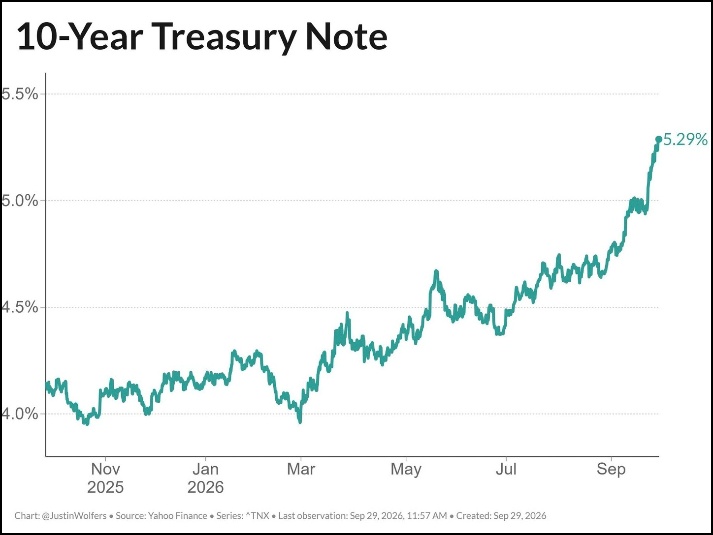
The rise in long-bond yields corresponds to a confluence of factors. Chief among them is inflation, which on an annual basis stood at 3.4% – based on the Consumer Price Index – above the Federal Reserve’s 2.0% target. Inflation has remained above the Fed’s target for 66 months. In response, Ken Warsh, the newly installed Federal Reserve Chairman, has committed to bringing down inflation to the Fed’s long-term target of 2.0%. In mid-September, the Fed raised interest rates for the first time in three years and may further commit to a more prolonged policy tightening cycle. The committee responsible for setting interest rates was unanimous in its decision to raise rates.
The impact of this decision is more consequential than prior increasing rate cycles due to levels of both public and private sector debt. U.S. federal government debt now stands at $40 trillion, while U.S. companies issued almost $1.7 trillion of debt through August.
Higher bond yields raise the cost of borrowing for companies and consumers, increase mortgage rates and lower corporate profits.
Investment in AI infrastructure and data centers in the U.S. is also putting pressure on interest rates with investment projected to total $10.3 trillion from 2025 to 2032. According to a study by the Brookings Institution, spending on data centers will represent an astonishing 3.6% of gross domestic product per year, on average. Risks in the financial sector are increasing as a growing share of this capital spending by major tech hyperscalers – that is, large-scale cloud service providers – is financed by debt. Tech companies alone issued $219 billion in bonds through August.
Although rising yields may burden borrowers—from highly leveraged consumers to governments—a more nuanced view is that central banks have suppressed interest rates worldwide. Two decades of central banks’ intervention have kept interest rates artificially low, which has facilitated an unsustainable borrowing binge by spendthrift governments. Rising rates can restore market pricing and provide a more accurate measure of credit risk. It also allows fixed income investors to earn a fairer return for the risk they are taking.
The risk inherent in higher yields underscores the importance of transparency in knowing what you own and actively monitoring and reviewing the fundamentals of each asset in one’s portfolio.
Yields returning to normal level is a stated goal of Kevin Warsh who wants the bond market’s signals to govern the Fed’s policy decisions, not vice versa. The historical long-term average of the U.S. 10-year Treasury yield is in the mid 5.0% range. Current yields are just approaching that level. Restoring market discipline and lowering artificial rates can improve the feedback loop for policy makers to make informed decisions on debt and spending levels.
The rise in Treasury yields offers both opportunities and heightened risk for investors. On the one hand, higher interest rates provide investors with the prospect of more fair compensation for the risk of holding bonds with longer-term maturities. There is simultaneously elevated risk of financial securities – both stocks and bonds – whose underlying issuer carries significant leverage. The risk inherent in higher yields underscores the importance of transparency in knowing what you own and actively monitoring and reviewing the fundamentals of each asset in one’s portfolio.
September 30, 2026
Company Comments
Comments follow regarding common stocks of interest to clients with stock portfolios managed by Delta Asset Management. This commentary is not a recommendation to purchase or sell but a summary of Delta’s review during the quarter.
The Walt Disney CompanyNYSE: DIS |  |
The Walt Disney Company is a global, diversified entertainment company with operations spanning theme parks, broadcast and cable television, movie production, consumer products and new online video streaming services. The company owns some of the world’s most valuable media brands including ABC, Disney, ESPN, Lucasfilm (Star Wars), Marvel and Pixar. Disney’s broad media and entertainment breadth provide diversified distribution channels for the company’s creative content. Over the last several years, Disney has focused on three key strategic priorities: creating high-quality content for the entire family; making that content more engaging and accessible through the use of technology; and growing its brands and businesses in markets around the world.
Josh D’Amaro became CEO on March 18, assuming the CEO mantle from Bob Iger. D’Amaro was chief of the theme parks division before being selected as CEO.
Disney has emerged as Netflix’s primary competitor in video on demand, as profitability continues to build in this segment. Streaming video should take on an even more central role in the distribution of the company’s entertainment content as ESPN continues its subscription video-on-demand evolution. We anticipate that the company will continue with its goals of pursuing profitability in video on demand from price increases and new bundling deals.
Sports are Disney’s major content edge. As consumer viewing options – internet and mobile media – grow and become more fragmented and as viewing preferences change, “must see” live sports provide ESPN with an advantage over its traditional cable distributors and advertisers. ESPN profits from the highest affiliate fees per subscriber of any cable channel and generates revenue from advertisers interested in reaching adults ages 18-49, a key advertising demographic that watches more sports and less scripted television than other groups. These recurring, high margin cable affiliate fees provide profit stability in most economic backdrops.
Disney has focused on three key strategic priorities: creating high-quality content for the entire family; making that content more engaging and accessible through the use of technology; and growing its brands and businesses in markets around the world.
Disney has invested heavily in its theme parks in the past few years, adding new attractions, new resorts and new cruise ships, as well as park expansions and upgrades. Disney parks are one-of-a-kind destinations that have competition, but few destinations can match the scale, distinctive appeal and broad family relevance of the Disney experience.
Disney does face long-term challenges. The cost of sports programming rights continues to rise sharply, and ESPN pays handsomely to acquire major sports contracts. ESPN has been able to defray some of these costs by charging ever-increasing affiliate fees to cable operators. With such high fees, angst is growing among viewers, cable operators and program competitors.
If ESPN cannot continue to pass along sports rights costs to cable operators, its profit margins will erode. However, profit erosion would be gradual due to ESPN’s long-term contracts with both major sports leagues and cable operators. The high value of sports has also created additional competition for ESPN. All major broadcasters, such as FOX and NBC, and the major sports leagues themselves have increased their investments in sports programming. More competition for viewers is likely to drive up the overall operating costs to broadcast sporting events over time.
Disney’s proven ability to develop entertainment icons with increased consumer opportunities from merchandising royalties, positive cable pricing, theme park expansion and new film and online TV streaming services should allow the company to continue its good revenue growth with solid operating profit margins. Our valuation model suggests that the company’s stock is priced to generate a long-term average annual rate of return of approximately 13%.
Emerson Electric Co.NYSE: EMR |  |
Emerson Electric has undergone one of the more significant transformations in the industrial sector over the past several years. Once viewed as a diversified industrial conglomerate, the company has reshaped itself into a focused industrial automation and software business through a series of acquisitions, divestitures and internal restructuring initiatives. Today, Emerson provides sensors, control systems, software platforms and test and measurement technologies that help manufacturers operate facilities more safely, efficiently and reliably. Its products are deeply embedded across a broad array of industries, including power generation, energy, chemicals, life sciences, semiconductors and aerospace and defense.
The appeal of Emerson's business model lies in the critical role its products play within customer operations. While automation equipment typically represents only a small percentage of a manufacturing facility's overall cost, these systems often govern processes where downtime can be extremely expensive. As a result, customers tend to favor proven suppliers and are reluctant to switch once equipment is installed and integrated into plant operations. This dynamic enables Emerson to have an installed base valued at approximately $155 billion and to generate roughly 65% of revenue from recurring sources such as maintenance, upgrades, software contracts and aftermarket services. In many cases, customer relationships extend for decades, supported by high switching costs, extensive technical expertise and the mission-critical nature of Emerson's solutions.
We believe Emerson's extensive installed base, strong market positions and high customer switching costs should allow the company to benefit from favorable industrial automation trends while expanding its software and recurring service offerings.
We believe Emerson is particularly well positioned to benefit from the ongoing digital transformation of industrial manufacturing, as manufacturers continue to equip their operations with smart technologies. Across global industries, companies are increasingly investing in automation, artificial intelligence, industrial software, predictive maintenance and connected devices, as they seek to improve productivity and address persistent labor shortages. Emerson's portfolio spans much of the industrial automation stack, from field-level sensors and valves to enterprise software platforms such as AspenTech, DeltaV, National Instruments and Ovation. The company’s end-to-end portfolio allows it to capitalize on many of the key adjacent growth themes within industrial technology, including electrification, nearshoring and the modernization of critical infrastructure.
Emerson’s recent strategic actions have further strengthened its competitive positioning, as the acquisitions of AspenTech and National Instruments significantly expanded Emerson's software capabilities and increased exposure to higher-margin, resilient revenue streams. Management has indicated that its portfolio transformation is largely complete and has shifted its focus toward organic growth, operational efficiency and shareholder returns. Demand indicators remain healthy despite pockets of industrial softness, with management highlighting strong activity in power-related projects, data center infrastructure, life sciences aerospace and defense and liquefied natural gas applications. Many of these markets are uniquely benefiting from the long-term trends detailed above.
While Emerson's long-term prospects remain attractive, potential risks and challenges do exist. Industrial automation remains cyclical and demand can weaken during periods of economic uncertainty as customers delay capital projects. Nonetheless, the company’s software contracts should smooth demand and reduce cyclicality. The company must also continue successfully integrating prior acquisitions and delivering the growth and synergy targets that justify those investments. Additionally, competition remains intense as both established industrial firms and emerging international competitors seek to capitalize on attractive automation end markets.
We believe Emerson's extensive installed base, strong market positions and high customer switching costs should allow the company to benefit from favorable industrial automation trends while expanding its software and recurring service offerings. We expect these advantages to support mid-single-digit annual revenue growth and operating margins averaging about 23% over our 10-year modeling period. Based on these assumptions, our stock valuation model indicates Emerson's current share price offers an average annual long-term rate of return of approximately 7.3%.
Avery Dennison CorporationNYSE: AVY |  |
Avery Dennison is the leading manufacturer of pressure-sensitive labeling materials. The company is also one of the world’s largest producers of retail apparel ticketing and branding systems, radio frequency identification (RFID) inlays and tags and specialty tapes. Avery has a significant global presence with approximately 200 manufacturing and distribution facilities in 50 countries and product sales in 89 countries. Nearly 70% of revenue is derived from international markets, including emerging markets.
The company maintains a dominant market share position in its two main businesses: pressure-sensitive materials, retail branding and information solutions. Avery’s specialization, superior product offerings and effective customer service should continue to strengthen its relationships in these businesses. Although both business segments have reached maturity in developed markets with pockets of excess growth remaining in specialty labels and RFID tags, Avery continues to build on its already significant international presence, particularly in Asia. Long-term, these economies should continue to grow the demand for packaged goods, and apparel will likewise increase. In addition to adding new regional partnerships, Avery grows as its multi-national customers expand into new, faster growing regions.
The company’s technical and engineering expertise has led to innovative new products, such as clear film labels and thinner, more flexible labels that conform to oddly shaped consumer packages and bottles.
Avery’s size affords it a manufacturing scale advantage. The firm’s extensive global distribution network and long-standing customer relationships further strengthen its advantages over its competition, particularly with large consumer products manufacturers, such as Procter & Gamble. These relationships can be “sticky” due to the tailored servicing involved. Meeting specific customer specifications and formats increases switching costs.
Pressure-sensitive materials is Avery’s most important business segment and contributes 76% of company profits. Avery is more than twice the size of its nearest competitor. The company’s manufacturing scale enables Avery to obtain operating efficiencies that generate a premium profit margin over its competitors. Further, its multi-year operating improvement plan continues to grow company profitability. The company’s technical and engineering expertise has led to innovative new products, such as clear film labels and thinner, more flexible labels that conform to oddly shaped consumer packages and bottles. These specialty labels are a faster growing segment of the market with premium operating margins. This technology is important to consumer products manufacturers for brand awareness and product appeal on the shelf.
We expect Avery will continue to benefit from the growing acceptance of RFID tags, which are rapidly growing and have become an increasingly important part of overall company holdings. RFID tags help companies manage their inventory and distribution. Avery dominates this space with annual revenue expected to continue to grow, with double digits going forward. Growth in web shopping and omni-channel retailing will continue to drive rapid growth for RFID inlays due to its inventory management advantages.
Given Avery’s concentration in mature markets and its increasing market share in faster-growing emerging markets, we have assumed the company can grow revenue approximately 4.2% annually over the next decade. At this pace, given the company’s operating efficiencies partially mitigated by competitive pressures, we believe cash flow margins can average approximately 15.5% during this period. Based on these assumptions, our stock valuation model indicates Avery’s current price offers a long-term average annual rate of return of approximately 10%.
United Parcel Service, Inc.NYSE: UPS |  |
UPS is the world’s largest package delivery company in an industry where network size matters, both in terms of customers and spreading costs over a larger volume of packages. The company was founded in 1907 as a private messenger and delivery service in Seattle, WA. For calendar year 2025, UPS delivered on average about 20.8 million packages per day, generating $88.7 billion in revenue.
The parcel industry enjoys favorable competitive dynamics. A start-up would find it difficult to replicate a competitive network quickly. The barriers to entry are high as carriers own and/or lease large fleets of airplanes and trucks, trailers, terminals, sorting equipment, drop boxes and IT systems. Despite its asset intensity and extensive unionization, UPS produces returns on invested capital ahead of its cost of capital and margins above its competitors. This achievement is due to the firm’s investment in technology and operational efficiency.
Over the past decade, UPS has significantly expanded the scope of its capabilities to include more than package delivery. Its logistics and distribution capabilities give companies the power to expand their businesses to new markets around the world. UPS provides shipping, logistics and return services for internet retailers whose sales are growing three to four times faster than those of brick-and-mortar stores.
The parcel industry is a major beneficiary of internet sales trends. Throughout the world, online buying has grown exponentially. We expect e-commerce growth to continue at a high rate over the long term. The gains from internet sales have recently been modestly tempered by product digitization and miniaturization, which reduces average package volume and weight.
Despite these trends, a broader selection of products is being purchased online as younger generations are more comfortable with online transactions.
The shift toward e-commerce has led to a structural increase in the capital required to meet ever-evolving customer demand. UPS invests a billion dollars a year in information technology investments. Such a level of commitment is a material part of its 2025 $3.6 billion plus capital expenditure. This investment has paid off in efficiency and reduced costs. For ground delivery, UPS indicates its ORION route optimization has reduced costs by $400 million.
Amazon has been insourcing more of its own last-mile delivery needs at a rapid pace. UPS’s revenue from Amazon fell to approximately $9.4 billion in 2025, and now accounts for just 10.6% of total revenue during 2025. In May of this year, Amazon announced it is opening its last-mile parcel delivery network to shippers outside of its own e-commerce network. We believe that UPS’s scale and global automation capabilities position it well to compete with Amazon now.
UPS provides shipping, logistics and return services for internet retailers whose sales are growing three to four times faster than those of brick-and-mortar stores.
The conflict in Iran has had a muted impact on UPS’s profits as adjustments for fuel prices are assessed weekly by management and passed on to customers.
In June 2023, UPS struck a new five-year deal with the International Brotherhood of Teamsters covering 250,000 workers. Although the agreement included rapid wage gains, UPS retained the ability to offset labor with automation. In the future, robotics may increase productivity and lower wage costs.
UPS has demonstrated high capital efficiency and strong cash flow generation throughout its history. The industry has benefited from three intertwined forces: the emergence of China, the broad trend toward just-in-time inventory and the rise of internet commerce. The company should continue to benefit from volume growth from businesses shipping to consumer, an oligopolistic industry structure and growing global trade and supply chains. Based on these assumptions, our stock valuation model indicates a long-term average annual rate of return of approximately 12%.
Stanley Black & DeckerNYSE: SWK |  |
Founded in 1843, Stanley Black & Decker is a global leader in providing hand and power tools and related accessories to consumers and industrial customers. The company has some of the leading tool brands including Craftsman, Cub Cadet, Dewalt, and Stanley Black & Decker.
Reliability and brand loyalty are important factors in the North American tool market. Customers have long memories and can be unforgiving if a manufacturer cuts corners. This brand consciousness helps Stanley in positioning with big box retailers. Retailers look for strong brands that command a premium margin and provide a broad umbrella of products to satisfy core customers. In 2025, the Tools and Storage segment of Stanley accounted for 87% of revenues. Brand loyalty of tools is very high across markets, and many users are willing to pay a premium price for quality products.
Historically, Stanley has been a serial acquirer and has a successful track record of integrating over 70 acquisitions since 2004. On average, Stanley has improved operating margins by six percentage points on acquired businesses. It absorbed the larger Black & Decker in 2010, significantly broadening its product portfolio and yielding revenue and cost synergies well beyond the original expectations. The merger has created the largest provider of hand and power tools with enormous global reach and channel access, including high growth in emerging markets. More recent acquisitions include the purchase of the 90-year-old Craftsman brand from Sears and the purchase of Lenox and Irwin from Newell Brands.
Stanley is sharply focused on driving organic growth, which has matched the robust recovery in housing and home improvement. Research and development investment is over $321 million or 2.1% of sales. With its increased innovation investments, the company’s product development plans are robust as it aims to nearly double the number of professional products offered over the next three years.
Stanley has taken a pause in acquisitions while it focuses on simplifying and streamlining manufacturing and sourcing and consolidating its tools and outdoor products where appropriate. Longer term, acquisitions will continue to play a role in the company’s outlook. The branded tool and storage products are critically important aspects of the company that provide strong free cash flow. Stanley will continue to invest in new product development – such as smart tools and higher battery voltage power tools – and increase its brand support through marketing and promotional activities.
With its increased innovation investments, the company’s product development plans are robust as it aims to nearly double the number of professional products offered over the next three years.
Acquisitions always introduce the risk of overpaying and later facing asset impairments or inadequate returns on invested capital. Stanley also faces commodity price risk. The company does have the benefit of a domestic supply chain as approximately 50% of the company’s North American tools are manufactured domestically. However, the company’s consolidated customer base and competitive markets may prevent Stanley from fully passing along rising costs in the form of price increases.
We believe Stanley can grow organically in the low single-digits. We also expect Stanley to resume its acquisition program and, when appropriate, to fund it through free cash flow and debt financing. Based on our projections, we anticipate operating margins on average of 8.5% over the forecast period. Given these assumptions, our valuation model indicates that the company’s stock is priced to generate an average long-term annual rate of return of approximately 9.0%.
September 30, 2026
Specific securities were included for illustrative purposes based upon a summary of our review during the most recent quarter. Individual portfolios will vary in their holdings over time in relation to others. Information on other individual holdings is available upon request. The information contained herein has been obtained from sources believed to be reliable but cannot be guaranteed for accuracy. The opinions expressed are subject to change from time to time and do not constitute a recommendation to purchase or sell any security nor to engage in any particular investment strategy. Any projections are hypothetical in nature, do not reflect actual investment results and are not a guarantee of future results and are based upon certain assumptions subject to change as well as market conditions. Actual results may also vary to a material degree due to external factors beyond the scope and control of the projections and assumptions.
Delta Asset Management · Memphis, Tennessee · deltaasset.com