

Q2 2026 Quarterly Newsletter
One of the most influential positions impacting the U.S. stock market is the Chair of the Federal Reserve (the Fed). New Chairman Kevin Warsh made his debut in June in which he unveiled an ambitious, but incremental, reform agenda. In a move to reassure those who support the Fed’s goal of price stability, he emphasized in a press conference that the Fed was “unambiguously and unanimously” committed to reining back inflation to the Fed’s 2.0% target.

Indeed, Fed policy makers voted 12-0 to leave the benchmark federal funds rate unchanged, holding to its current range of 3.5% to 3.75%. The decision to keep rates unchanged followed the same approach used by Warsh’s predecessor, Jerome Powell, who also held rates steady in January, March, and April after last year’s rate cuts. By not cutting rates further, the Fed avoided adding to inflationary pressure.
Investors took this step as a signal that the new Chairman would champion the central bank’s independence and be open to rate increases, if necessary, despite his appointment by President Trump who has strenuously advocated for lower rates. In contrast, Warsh repeatedly noted that inflation has run above the Fed’s 2.0% target for years and recommitted the Fed’s mandate to curb price increases.
Despite this consistency in Fed policy, there were signals that the new Chairman will mark his tenure with material changes in style and substance from his predecessors. Warsh prefers to abstain from providing forward guidance – public signals about the Fed’s likely future interest rate decisions - and to limit communication, believing that too much advance signaling can weaken, rather than strengthen, the central bank’s credibility and flexibility to respond to market changes. The policy statement from the June meeting was a scant 130 words compared to the previous 341 and did not include forward guidance.
The Fed has a reputation for missing predictions about inflation, gross domestic product (GDP) growth and unemployment. It underestimated inflation in 2021 and 2022, calling inflation “transitory”; it overestimated economic growth in 2011 and 2012 (3.0% to 1.5%); and it underestimated the growth in 2017 and 2019 from tax cuts.
In June, Warsh announced he would create five task forces on communications, the Fed’s balance sheet, data the Fed uses, the effects of productivity changes – including artificial intelligence (AI) – on jobs and the economy, and the Fed’s inflation framework.
Warsh strongly supports shrinking the Fed’s balance sheet, which would strengthen market forces’ impact on interest rates. When the Fed reduces its balance sheet by selling bonds, this action reduces the money supply, which in turn generally puts upward pressure on long-term interest rates.
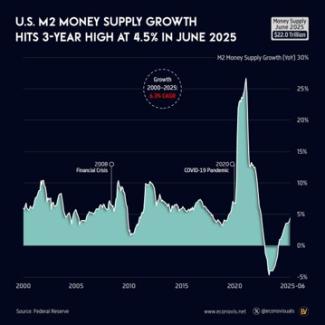
Since the 2008 financial crisis, the Fed has been far more active in buying bonds and paying interest rates to banks – with its balance sheet growing to $6.8 trillion. Large Fed balance sheets contribute to the growth in the money supply leading to inflationary pressures. M2 – a common and broad measure of the total money circulating in the U.S. economy – increased 19% in 2020, proceeded by 16% in 2021 and was a significant factor in inflation during the subsequent period that followed.
We are early in Warsh’s potentially consequential tenure as Fed Chairman. He has already paradoxically carried forward the interest rate policies of his predecessor while simultaneously putting into place mechanisms that could alter how the Fed operates with implications for both financial markets and investors.
Company Comments
Comments follow regarding common stocks of interest to clients with stock portfolios managed by Delta Asset Management. This commentary is not a recommendation to purchase or sell but a summary of Delta’s review during the quarter.

Solstice Advanced Materials, Inc. { SOLS }
Solstice Advanced Materials is a leading producer of specialty chemicals and materials used in refrigerants, building insulation, uranium conversion, semiconductors and electronics, defense products and healthcare packaging. The company completed its spinoff from Honeywell Technologies in late 2025.
Solstice operates with two segments based on product category. Refrigerants & Applied Solutions generated over 70% of revenue in 2025. Within this segment, the largest product category is refrigerants, which contributed nearly 40% of companywide revenue in 2025. Solstice is a leader in hydrofluoroolefins – or HFOs – which are the refrigerants with low global warming potential as they dissolve in the atmosphere in days or months versus years with older refrigerants.
HFOs are replacing hydrofluorocarbons – or HFCs – which incorporate a high level of greenhouse gases used in commercial refrigerants and air conditioning systems. Climate scientists refer to HFCs as high global warming potential, meaning they are easily trapped in the earth’s atmosphere and are prone to leaks through cracks in refrigeration systems. Solstice should also benefit from the current data center buildout as data centers require refrigerants.
In addition to the Refrigerants division, the company has an Electronics & Specialty Materials segment that generated approximately 30% of revenue in 2025. The division comprises materials used to produce semiconductors and electronics. This business should benefit from growing global demand for semiconductors and smaller nodes, which require more advanced materials.
Solstice, with joint venture partner General Atomics, operates the only U.S. uranium conversion plant. Although uranium is a commodity, the company has an intangible asset from a regulatory license for uranium conversion with the U.S. Nuclear Regulatory Commission that runs until 2060. U.S. nuclear power generation is set to grow as at least two plants are scheduled to reopen in the next several years. As a result, Solstice’s Metropolis, IL plant has been able to sign long-term sales agreements with lower price volatility.
Because Solstice’s facility is the sole domestic facility producing uranium hexafluoride gas, the Department of Energy (DOE) has entered into an agreement with the company pursuant to which the DOE will share in certain costs in connection with the expansion of its facility.
We believe that Solstice’s Refrigerants & Applied Solutions and Electronics & Specialty Materials divisions should produce steady growth with the global transition to alternative energy and lower impact carbons. Based on our assumptions, our financial model indicates a potential long-term annual return of approximately 11%.

Accenture { ACN }
Accenture is one of the largest information technology (IT) providers in the world, offering solutions for specific enterprise problems as well as strategy and advertising consultancy. The company has a broad top-tier client base, integrating and developing software for 80% of the largest global 500 companies. Of Accenture’s top 100 clients, all have been with them for 10 years or more. Accenture achieves sought after scale and servicing by employing nearly 800,000 people throughout 120 countries. Customer relationships and multi-industry expertise set Accenture apart from its peers. The company has approximately 300 clients contributing more than $100 million in annual revenue.
Many of Accenture’s clients are in the early stages of their digital transformations and recognize that technology is central to their business. The firm provides large systems integration for companies such as Microsoft, Oracle, Salesforce, SAP and Workday. Its engineers customize the software to the client’s needs by building capabilities, connecting databases, or adding extra analytics. Accenture’s personnel are often embedded throughout a client’s business. In developing expertise across a wide spectrum, Accenture can develop best industry practices and apply solutions across its client base.
Outsourcing is another side of the Accenture’s business model. It focuses on repeatable business processes, such as data centers, accounting, procurement and application services. After a software integration project, clients can choose to have Accenture manage and maintain software and systems in various departments. These contracts span several years, and there is significant investment by the client making it difficult for Accenture to be displaced.
The company is continually adapting new technology and services to remain relevant and engaged with its most important customers. Accenture consistently invests over $1.0 billion annually in research and development and has over 8,300 patents and pending patent applications. At the same time, the company has invested $6.6 billion across 46 acquisitions to gain additional skills and talent in high-growth areas of the market. Accenture recently announced a three-year, $3.0 billion investment in generative AI to help clients across all industries achieve greater growth and efficiency. This investment has generated strong demand, with significant new AI bookings to date. The investments should continue to allow the company to provide cutting edge solutions in AI, blockchain, quantum computing, cybersecurity and more. Accenture is well positioned to take advantage of accelerated consulting and outsourcing demand driven by the digitization of the global economy.
The IT service industry, including Accenture, is subject to the overall cyclicality of enterprise IT spending, which has been weaker of late as many companies have faced a tougher business environment. Recently, the U.S. federal government has put many federal consulting contracts under closer review. Longer-term, growth of AI agents could shift enterprise spending in certain low-end areas away from outsourcing firms such as Accenture. Yet, as a top service provider, we believe Accenture will play an important role in helping corporate clients best utilize AI agents, which should help drive additional growth for the company.
Based on the financial characteristics we have outlined, we assume Accenture can grow its revenue at an annual average rate of approximately 4.0% organically over the next decade. At this pace of growth and given improved efficiency, operating margins can average 15.7% during our forecast period.

Procter & Gamble Company { PG }
Since its founding in 1837 by William Procter and James Gamble, Procter & Gamble (P&G) has grown into one of the world's largest and most profitable consumer products companies. The company generates more than $84 billion in annual sales with over $20 billion in operating profit, serves consumers in over 180 countries and territories and owns a portfolio of leading brands including Charmin, Crest, Dawn, Gillette, Olay , Oral-B, Pampers and Tide. More than 20 of P&G’s individual brands generate over $1.0 billion in annual revenue, and many hold the No. 1 or No. 2 market share position in their categories.
P&G’s success has been built on a long-standing business model: Discover meaningful consumer insights as to their needs and wants through deep consumer research and understanding; translate those insights into product innovation; and create compelling marketing and advertising to convince consumers of the superior performance and value of P&G products. The company spends billions of dollars annually on advertising – more than $9.0 billion – and research and development – more than $2.0 billion – which helps maintain the strength of its brands while reinforcing its premium positioning across a broad range of consumer categories.
The company operates through five major segments: Baby, Feminine & Family Care; Beauty; Fabric & Home Care; Grooming; and Health Care. This broad diversification across products and geographies provides stability and helps reduce exposure to weakness in any single market. Over the past decade, management has streamlined the organization, focusing resources on its strongest brands while investing heavily in automation, digital capabilities and supply chain efficiency. Ecommerce now represents approximately one-fifth of company sales and continues to be an important source of growth.
Management remains focused on driving sustainable organic growth through innovation, premiumization and market share gains. These efforts – combined with ongoing investments in automation, AI, productivity initiatives and disciplined portfolio management – have produced industry-leading profitability. In fiscal 2025, P&G generated operating margins of more than 24%, achieving its long-term profitability objective three years ahead of schedule.
In light of these achievements, strategic continuity remains a strength for P&G, as Shailesh Jejurikar succeeded Jon Moeller as Chief Executive Officer in January 2026 after more than three decades with the company. Having previously led several of P&G's largest businesses and served as Chief Operating Officer, Jejurikar has been instrumental in many of the company's recent productivity, supply chain and innovation initiatives. His appointment supports a consistent strategic direction focused on brand investment, operational excellence and long-term shareholder value creation.
Despite these developments, P&G faces competition from both global consumer product companies and increasingly capable private-label brands. Consumer spending pressures, commodity cost inflation, foreign currency movements and retailer consolidation also represent ongoing risks. However, the company’s scale, extensive distribution network, history of meaningful innovation and portfolio of trusted brands provide meaningful competitive advantages that have allowed it to maintain attractive margins and leading market positions across many categories, resulting in return on invested capital exceeding 20% in 2025.
P&G also maintains a strong AA-rated balance sheet and generates substantial cash flow. In fiscal 2025, the company produced approximately $14 billion of free cash flow while continuing to invest heavily in innovation, manufacturing capabilities, and brand development.
The company has a long history of returning capital to shareholders through dividends and share repurchases. P&G has paid a dividend for more than 130 consecutive years and has increased that dividend annually for seven decades, an achievement matched by only one other publicly traded U.S. company.
Given P&G's strong portfolio of category-leading brands, substantial free cash flow generation and long history of innovation, we believe the company is well positioned to grow revenue at an average annual rate of approximately 3.3% over the next decade. We also expect continued productivity gains from automation, supply chain optimization and portfolio management to support operating income before depreciation and amortization (OIBDA) margins near 27.3%. Based on these assumptions, our valuation model indicates P&G's current stock price offers a long-term average annual rate of return of approximately 7.0%.

Adobe Inc. { ADBE }
Adobe is one of the most diversified software companies in the world with solutions that span from digital media to digital design experience. Based on San Jose, CA, Adobe’s products are organized into primarily two segments: The flagship digital media segment, which comprises over 70% of the revenue and includes the Create Cloud and Document Cloud business with such applications as Acrobat and Photoshop; and the Digital Experience enterprise marketing platforms.
Founded in 1982, the company’s products are used by photographers, video editors, graphic and experience designers, game developers, advertisers and content creators from businesses of all sizes. Its products and services are marketed directly to enterprise customers through its sales force and local field offices.
Adobe licenses its products to end users through its own app and website using term subscription and pay-per-use models. In fact, nearly all of its products are now sold through a subscription software model where customers purchase access to a product for a specific period during which they have the right to use the most recent version. The company automatically provides updates and enhancements when available. Adobe’s benefits of the subscription model include improved revenue visibility, the elimination of piracy and a much lower cost to provide the service.
One of the company’s first products, Acrobat and the well-known PDF file standard created by the company, is now a multi-billion-dollar business. The ascent of smartphones and tablets combined with flexible and mobile work arrangements have made this flexible use product more relevant than ever. Adobe believes the addressable market for Document Cloud is greater than $200 billion.
Another iconic product – Photoshop, introduced in 1989 – has quickly become the industry standard for image editing software. Adobe has consistently upgraded the product, introduced new features and added applications. Such products benefit from a network effect. By virtue of widespread adoption, users have a significant incentive to become well versed and invested in the software. Photoshop has become such a standard in the creative world that major university design programs incorporate Adobe’s Creative Cloud applications in their curriculum.
The debut of the Firefly product in 2023 introduced AI solutions that have attracted new users. Adobe can improve customer creativity and productivity as it adds AI solutions to its suite of products and expands cross-selling opportunities. Adobe has positioned itself to be a key player in creative AI. The company is now executing a pivot to become the default AI platform for creativity and productivity by scaling Firefly across first party models, embedding agents in Acrobat and partner models such as ChatGPT, Claude and others.
Adobe faces challenges and uncertainty related to AI. Fundamental performance including double-digit revenue growth, increasing profitability and historically high free cash flows are significantly discounted due to the threat of AI disruption to its business model. There is concern that AI will pressure pricing and the seat count in the firm’s subscription business model. This concern spans most software companies, not just Adobe. In addition, the company’s long-time CEO Shantanu Narayen is stepping down. He will remain CEO until his replacement is found.
Adobe remains a premier content creation and digital marketing powerhouse for both enterprise and consumers. Adobe is well positioned to capture AI opportunities given its sizable and knowledgeable user base and the company’s rapid development of its AI applications. Based on our assumptions, we project Adobe’s average revenue growth in the range of 5% and operating margins of 29% over our forecast period.
June 30, 2026
Specific securities were included for illustrative purposes based upon a summary of our review during the most recent quarter. Individual portfolios will vary in their holdings over time in relation to others. Information on other individual holdings is available upon request. The information contained herein has been obtained from sources believed to be reliable but cannot be guaranteed for accuracy. The opinions expressed are subject to change from time to time and do not constitute a recommendation to purchase or sell any security nor to engage in any particular investment strategy. Any projections are hypothetical in nature, do not reflect actual investment results and are not a guarantee of future results and are based upon certain assumptions subject to change as well as market conditions. Actual results may also vary to a material degree due to external factors beyond the scope and control of the projections and assumptions.